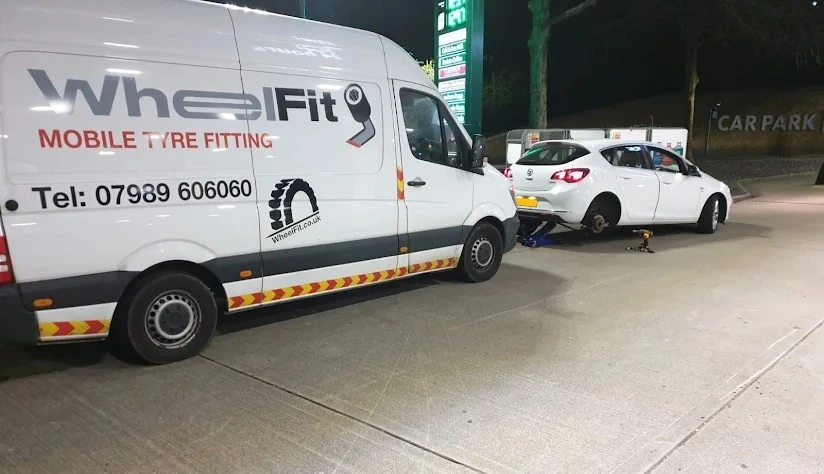
We Come To You!
Our mobile tyre fitting service is your convenient solution

Need a tyre in Pinner?
Tell us your tyre size and where you are — we quote before we set off.


Areas We Cover
Drivers across England and Wales — maximum 60 minute response
Popular Tyre Brands Available
We supply & fit new, high-quality and branded tyres for all major vehicles









See what our customers think
Browse through our customers testimonials.
Mobile Tyre Fitting in Pinner
Pinner, the High Street and the fair week — 24 hours a day.
Maximum 60 minute response. We have drivers across England and Wales, so a call gets a fitter to the vehicle rather than you moving a car that is not safe to move. Call 07989 606060 with your tyre size and location.
Pinner's centre is medieval in plan. A single High Street runs up to the parish church of St John the Baptist, which stands at the top where the road meets Church Lane and Grange Gardens and has been there since the fourteenth century. Below it, Bridge Street is wider, busier and mostly chain shops. Twenty-six listed buildings sit inside the conservation area covering the two.
Once a year that whole centre shuts. Pinner Fair has been held under a charter granted by Edward III in 1336, which makes it one of the oldest chartered fairs in the country, and it is still run in the street rather than on a field somewhere.
Roads we get called to around Pinner
- The High Street, running up to the church.
- Bridge Street and the junction at the bottom of it.
- Marsh Road and Eastcote Road heading south.
- Pinner Road, the A404, east towards North Harrow.
- Chapel Lane and the station car park.
- West End Lane, which takes the diverted buses during the fair.
The fair, and the two nights the centre is out of use
The fair falls in late May, on a Wednesday — in 2026 it ran on the 27th. What catches people out is the length of the closure. Roads went shut from around three in the afternoon on the Tuesday and were not reopened until about eight on the Thursday morning, so the centre is unusable for the best part of two days rather than for an afternoon.
The station car park closes with it. Buses divert down West End Lane. Nothing on wheels gets into the closed section while the rides are up, and that includes us. If your car is parked inside the closure with a flat tyre, it stays there until the fair comes down, and there is no arrangement that changes that. If you leave a car in central Pinner in the last week of May, read the notices before you walk away from it.
The two halves of the centre
The High Street and Bridge Street behave completely differently and it is worth saying which you are on. The High Street is narrow, the buildings come to the back edge of the footway, and it is lined with short-stay bays that turn over constantly — a poor place to have a vehicle standing still. Bridge Street carries more traffic but has more room either side of it.
In practice, most of our Pinner jobs in the centre happen either in the station car park or in one of the side turnings rather than outside the shop the car stopped in front of. Away from the centre it is straightforward suburban work on driveways, and the River Pinn crossings are the only other pinch points worth mentioning.
We also cover Hatch End to the north-east, North Harrow down the A404 and Eastcote to the south-west.
What we can do in Pinner
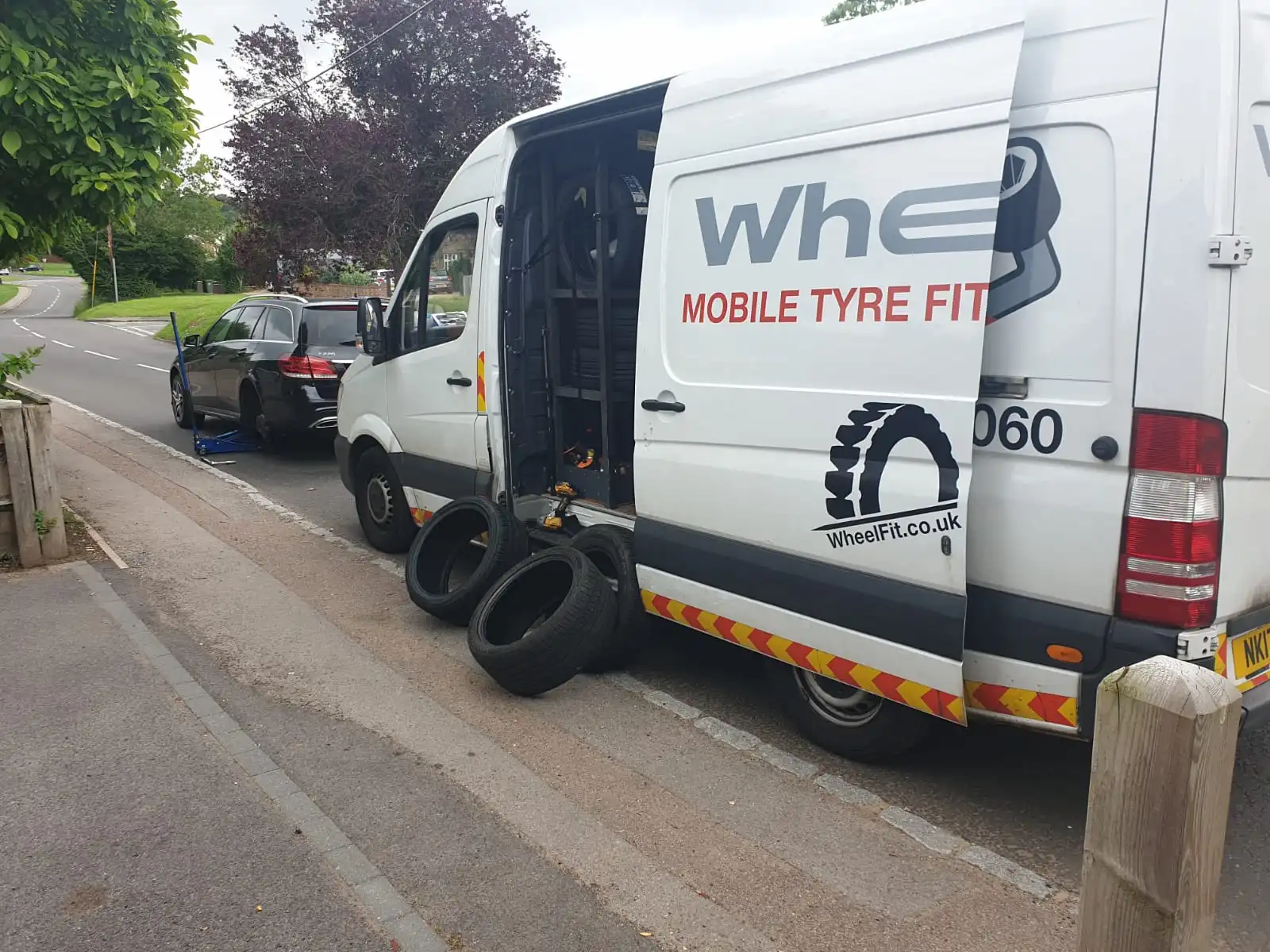
- Mobile tyre fitting — supply and fit a replacement at your home, workplace or the roadside, including balancing and disposal of the old casing.
- Mobile puncture repair — where the damage is inside the repairable area of the tread, a repair is cheaper and quicker than replacement.
- Commercial tyre fitting — vans, minibuses and other light commercial vehicles.
Stuck in Pinner right now? Call 07989 606060 and we will tell you what we can do and what it will cost before we set off.
Before we arrive
- Find your locking wheel nut key. Without it the wheel cannot come off. It is usually in the glovebox, the boot well, or with the spare.
- Read your tyre size off the sidewall, for example 205/55 R16 91V, so we arrive with the right tyre rather than making a second trip.
- If you are on a motorway or dual carriageway, get as far left as you can or into a refuge, then everyone out through the passenger doors, over the barrier and well back from the carriageway — not in the car. Ring with the junction number and your direction of travel.
- Describe where you are, not just your postcode. A junction number, a bay number, a farm, a pub or a bridge puts us on the spot far faster — rural postcodes can cover a mile of near-identical lane. We bring our own lighting, so darkness is not a problem.
More detail in our guides on what to do with a flat tyre on the motorway and checking your tread depth.
Repair or replace
Whether a tyre can be repaired is decided by where the damage is, not by how big the hole looks. Damage inside the central three-quarters of the tread, up to 6mm across, is repairable under BS AU 159. Damage in the shoulder or the sidewall is not, at any size — there is no way to reinforce a sidewall that flexes on every revolution.
The other thing that rules out a repair is having driven on the tyre flat. A short distance is enough: the sidewall folds under the rim and the internal cords break. That often does not deflate the tyre at the time — it shows up days later as a soft rounded bulge, and a tyre in that condition has to be replaced whatever the original puncture looked like.
How the damage was made matters as much as where it is. A nail or a screw pierces, leaving a neat hole that is usually well within the limit. Flint, crushed stone, quarry aggregate and dropped stainless fixings cut instead — a gouge or a tear rather than a puncture — and a cut frequently exceeds the repairable size even when it lands squarely in the middle of the tread. That is why we take the tyre off and look inside before telling you either way, rather than judging it from the outside.
Impact damage behaves the same way. A pothole or a kerb taken at speed compresses the suspension fully and pinches the sidewall between the rim and the obstacle. If that has happened, check both tyres on that side — the rear takes the same hit a fraction of a second after the front — and look for a bulge rather than for a hole.
We carry both outcomes to every job, so a repair that turns out not to be safe does not become a second visit.
Age and wear
Tread depth is not the only thing that retires a tyre. Rubber hardens as it ages whatever the mileage, which is why a caravan, motorhome, trailer or second car can carry almost full tread on a casing that is well past useful life. The four-digit date code on the sidewall gives the week and year it was made — our guide on how long tyres last covers where the line falls.
Depth matters most in standing water. The legal minimum is 1.6mm across the central three-quarters, but a tyre's ability to clear water falls off well above that — by about 3mm you are losing it noticeably, and aquaplaning starts at lower speeds than most drivers expect. Our tread depth guide covers checking it with a 20p coin in about a minute.
Wear patterns are worth reading too. Both outer shoulders going before the middle usually means underinflation, or a lot of cornering and hill descent; one edge alone is more often alignment. We will tell you which it looks like when we are there — see uneven tyre wear for the full picture.
Vans and light commercials
A van needs a tyre carrying the C marking and the correct load index. That is not interchangeable with a passenger tyre of the same nominal size, whatever may have been fitted before — the casing is built to carry more, and a loaded van on passenger-rated tyres is running outside the rating.
Tell us whether the van is loaded when you ring, and we will bring the right fitment first time. Details of what we carry are on the commercial tyres page.
How the repair is done
The wheel comes off, the tyre comes off the rim, and the inside of the casing is inspected before anything else happens. The puncture is then repaired from within using a combined plug and patch, and the wheel is balanced before it goes back on.
That inspection is the part that matters. An external plug pushed into the tread without removing the tyre is a get-you-home measure: it can seal the hole while leaving damage inside the casing entirely undetected, and that damage is what causes tyres to fail later at speed. It is the same job a garage does, done where the vehicle already is.
A slow leak with no puncture to find
A tyre that loses air over days with nothing in the tread has usually failed at the seal rather than the surface — a corroded alloy bead seat, or a perished valve stem. Neither can be found with the tyre still on the rim, and neither is fixed by topping the pressure up.
It typically announces itself on the first cold morning of the year. Cold air contracts, dropping the pressure a few PSI, and a leak that was tolerable through mild weather is a visibly flat tyre by the time you come out to the car. The fix is the tyre off the rim, the sealing face cleaned back to sound metal, and a new valve.
Working conditions around Pinner
Station and workplace car parks. A commuter car park is where slow punctures hide. Eleven hours standing with a short drive at each end means you never drive far enough or fast enough to feel a tyre going down — so it presents as a flat at six in the evening rather than as a soft one in the morning. These are also the easiest jobs we do: the car is stationary for hours, the surface is flat, and there is room to work. Leave us the bay number and where the locking wheel nut key lives and it is finished before you are back, which beats finding it flat at the end of the day.
Common questions in Pinner
- My car is inside the fair closure. Can you get to it?
- No, and nor can anyone else. The closure runs from the afternoon before until the morning after, and the rides occupy the carriageway. It has to wait until the road reopens.
- When is the fair, so I can move the car?
- Late May, on a Wednesday, with closures from mid-afternoon the day before. Harrow publishes the roads affected each year and the station car park is normally one of them.
- Can you work on the High Street on a normal day?
- Sometimes, at the quieter end, but it is narrow with constant turnover in the bays. A side turning or the station car park is usually the better call and rarely more than a minute away.
- The station car park is shut. Where else?
- Tell us where the car actually is and we will work with that. During fair week the sensible answer is normally a residential road outside the closure rather than anywhere in the centre.
- Do you cover Pinner Green and the Marsh Road end?
- Yes, all of HA5 on the Harrow side.
Not in Pinner?
We cover the rest of West London and beyond. If you are closer to one of these, the same service and the same number applies:
- Mobile tyre fitting in Acton
- Mobile tyre fitting in Alperton
- Mobile tyre fitting in Bedfont
- Mobile tyre fitting in Brentford
- Mobile tyre fitting in Brook Green
- Mobile tyre fitting in Chiswick
- Mobile tyre fitting in Cowley
- Mobile tyre fitting in Cranford
- Mobile tyre fitting in Dollis Hill
- Mobile tyre fitting in Ealing
- Mobile tyre fitting in Eastcote
- Mobile tyre fitting in Feltham
Why use a mobile fitter?
You do not have to move a vehicle that is not safe to move. No limping to a garage on a space-saver, no waiting room, and no second trip to collect the car.
We bring the same equipment a garage would use, wheel balancing included, to wherever the vehicle already is.
Tyre brands we supply
We stock across three tiers so you can balance cost against tread life and wet-weather performance. If you tell us your budget, we will say honestly which tier makes sense for the mileage you do.
Budget and mid-range
- Farroad
- Hifly
- Churchill
- RoadX
- Infinity
Premium
- Michelin
- Pirelli
- Bridgestone
- Goodyear
- Continental
Need a brand that is not listed? Call us and we will check availability for your size, or see how mobile tyre fitting works.